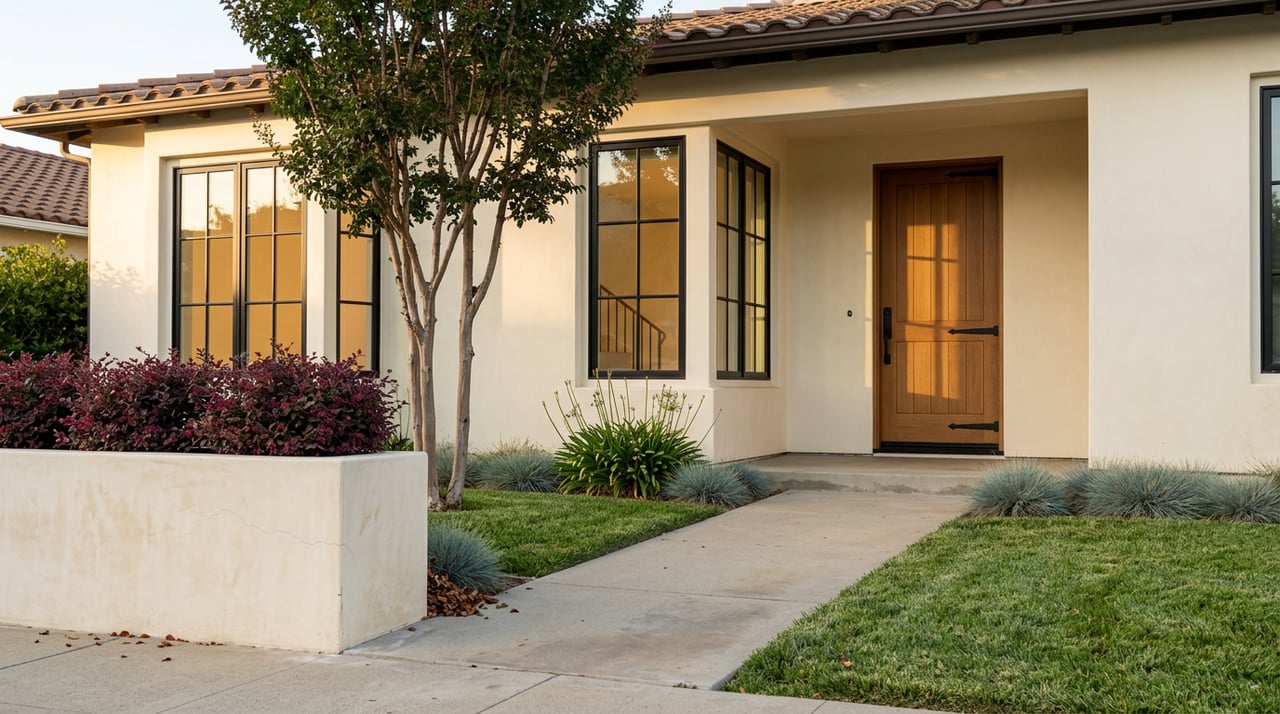
What a Fremont Address Actually Buys, Street by Street
August 20, 2026
August 20, 2026
Walk two open houses on the same block in Fremont's 94539 ZIP code and you might assume you're comparing apples to apples. Same street, same age of construction, same distance to the freeway. Then an agent mentions, almost in passing, that one house feeds Mission San Jose High School and the other does not. Nothing about the exterior gives it away. The listing photos look the same. The difference lives in a boundary line that runs through the middle of a residential grid, invisible on the sidewalk and not always apparent in listing information.
That line, more than any single amenity, explains why Fremont's median price tells you almost nothing useful. Depending on whether a source is tracking closed sales or modeling the entire housing stock, you'll see the citywide median quoted anywhere from roughly $1.4 million to $1.6 million through mid-2026. Both numbers are defensible. Neither tells you what a specific street will cost, because Fremont is not one market. It's five historic townships stitched into a single city limit, and the price gap between them has less to do with curb appeal than with two forces buyers rarely think to ask about: which school cluster a parcel falls into, and how close it sits to the transit and job engine reshaping the city's southern half.
Fremont incorporated in 1956 by merging five separate communities: Mission San Jose, Centerville, Niles, Irvington, and Warm Springs. Each kept its own identity, and each now trades in a different price band.
| District | Typical single-family range (2026) | Primary price driver |
|---|---|---|
| Mission San Jose | Roughly $2.0M to $2.3M+ | School attendance boundary |
| Warm Springs / Irvington | Roughly $1.3M to $2.0M | BART access, tech employment, newer construction |
| Centerville | Roughly $1.2M to $1.8M | Central location, older mixed housing stock |
| Niles | Below the citywide median | Historic small-town character, older inventory |
Mission San Jose sits at the top not because the hillside lots are inherently better built than a comparable house in Centerville, but because of what happens at drop-off time. Centerville, by contrast, is served by Washington High School or American High School depending on the exact address, and its housing stock runs older, a mix of 1950s bungalows and 1970s conventionals that command less per square foot even with a similar commute. Niles keeps its own identity as Fremont's most architecturally distinct pocket, a preserved village district near the Alameda Creek trail corridor, and its price point reflects an older, smaller housing stock rather than a lack of demand.
Here's the mechanism that actually sets the Mission San Jose premium. Four elementary schools feed the Mission San Jose cluster: Mission San Jose Elementary, Mission Valley Elementary, Gomes Elementary, and Chadbourne Elementary. All four route into Hopkins Junior High for grades seven and eight, which then feeds Mission San Jose High School for grades nine through twelve. That chain of feeder schools is what buyers are actually pricing in when they pay a premium for "Mission San Jose."
The trouble is that Fremont Unified School District draws these boundaries street by street, not by ZIP code. A home in 94539 is not automatically inside the Mission San Jose cluster. It might sit two streets over from a home that is. Listing portals pull school assignment data from aggregated feeds that update on their own schedule, so an address near a boundary may not be represented accurately. A buyer who trusts the school badge on a listing page rather than verifying the parcel directly with the district can end up paying Mission San Jose money for a house that, on paper, belongs to a different cluster entirely.
If a school boundary matters to your decision, the only reliable move is to confirm the specific parcel through Fremont Unified School District's own boundary tools rather than the school field on a listing site, and to get that confirmation in writing before you write an offer.
Warm Springs has its own quirk worth knowing before you tour there. It's the only neighborhood in the district with a split-grade elementary structure. James Leitch Elementary serves transitional kindergarten through second grade only. A few blocks away, Warm Springs Elementary picks up third through fifth grade only. Both schools then feed into Horner Middle School and eventually Irvington High School. It's a small detail, but it means a family moving into Warm Springs with a kindergartner and a fourth grader will have children at two different elementary campuses simultaneously, something that rarely shows up in a listing description and often surprises buyers who assumed one elementary school covers the whole neighborhood.
Warm Springs commands its own premium, and it has nothing to do with school rankings. It's driven by an entirely separate engine: the Fremont Innovation District, which wraps around the Warm Springs/South Fremont BART station and Tesla's factory. The station opened for revenue service on March 25, 2017, and the city's economic development office has designed the surrounding area to eventually support more than 40,000 technology jobs by 2035.
Tesla remains the anchor tenant, but the district's employer list runs wider than most buyers assume, including:
Tesla itself is mid-pivot. Reporting from CoStar in February 2026 described the company leasing a 108,000-square-foot research and development facility near its Fremont factory as it shifts toward Optimus robot production, with a stated goal of eventually building up to a million robots a year at the site. A second, larger industrial building near the factory, more than twice the size of that new lease, is also on the market. Whatever exactly gets built there, the direction is clear: Fremont's south end is doubling down on advanced manufacturing employment, not winding it down.
A future Irvington BART station, positioned roughly halfway between the existing Fremont and Warm Springs stations, is also in the pipeline, backed in part by $120 million secured through Alameda County's Measure BB. When that station opens, it will effectively extend the transit-adjacent premium further north into a part of the city that currently sits outside easy walking distance of either existing stop.
None of this shows up in a Mission San Jose listing. It's a separate value proposition entirely, built on commute time and job proximity rather than a feeder-school chain, and it's the reason Warm Springs can command well over a million dollars for a home with average schools while a comparable Centerville house, closer to neither BART station, sells for less.
Before you let a listing's stated school district or a portal's neighborhood label drive your offer, separate the two mechanisms at work. If a specific school assignment is part of your decision, verify the parcel directly with Fremont Unified rather than trusting the school field on a listing site. If commute time to the Innovation District or BART access is the priority, the school ranking matters less than the walk time to the platform and the pace of what's still being built around it. Treating Fremont as one market, priced off one median, is how buyers end up either overpaying for a school boundary they never actually landed inside or underpaying attention to a transit story that's still unfolding two BART stations south.
Does a 94539 ZIP code guarantee Mission San Jose schools? No. FUSD draws these boundaries by street, not ZIP code. Confirm the exact parcel with the district before assuming a specific address is inside the cluster.
Is the Warm Springs premium about schools too? Not primarily. Warm Springs and Irvington pricing tracks more closely with BART access and the Innovation District's employment growth than with school rankings.
Should I expect my kids to attend the same elementary school if I move to Warm Springs? Check first. Warm Springs is the one FUSD neighborhood with a split-grade structure, so children in different grades may attend different elementary campuses even at the same address.
Fremont rewards buyers who ask what's actually driving a number before they fall for it. If you're comparing districts, verifying a boundary, or trying to weigh a school premium against a transit premium, I'd rather walk you through the specific parcel than rely on a portal's school field. Shawn Shokoor works this market street by street. Let's Connect.
Stay up to date on the latest real estate trends.
Shawn believes buying or selling a home takes strategy, skills, and knowledge at the same time. He loves to help people! Nothing gives him greater satisfaction than seeing his clients reach their goals.
Shawn Shokoor | CA DRE# 01458772
(925) 315-9202
(408) 821-4180
[email protected]
760 Camino Ramon
Danville CA 94526
Office Hours
Monday to Sunday - 9:00 AM to 8:00 PM