Castro Valley Hills vs Flats: Find Your Best Fit
June 11, 2026
June 11, 2026
If you are deciding between a hillside home and a downtown-adjacent home in Castro Valley, you are really choosing between two very different ways of living. One offers a more terrain-shaped setting with larger lots and more separation, while the other puts you closer to BART, shops, and everyday errands. If you want to understand how those tradeoffs may affect your routine, your commute, and your long-term comfort, this guide will help you compare the two clearly. Let’s dive in.
In Castro Valley, “downtown” usually means the central core around Castro Valley Boulevard, Redwood Road, Lake Chabot Road, and nearby blocks connected to the I-580 corridor. Alameda County planning documents treat this area as the Central Business District, which is different from the surrounding hillside residential areas.
That planning distinction matters because it shapes the kinds of homes you are more likely to find. The central area allows medium-density, high-density, and mixed-use residential categories, while hillside neighborhoods follow separate standards designed for steeper terrain and other site-specific conditions.
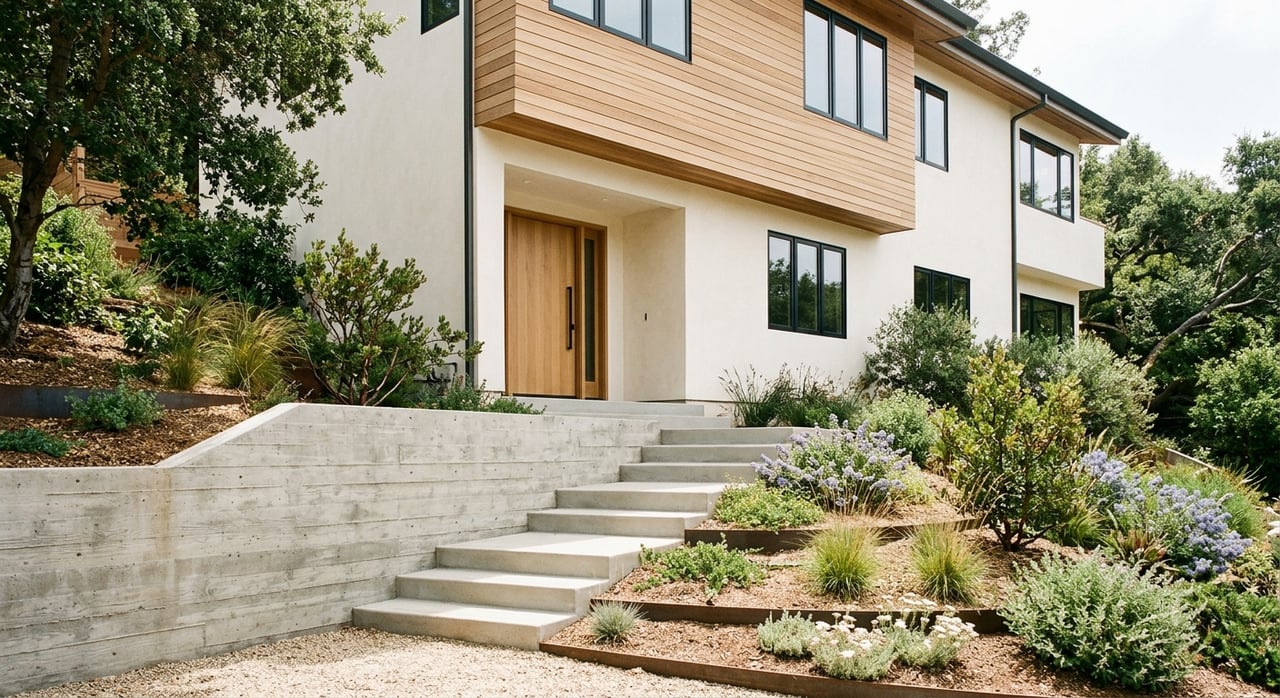
Hillside homes in Castro Valley are generally tied to areas with steep slopes or higher fire hazard near regional open space. Alameda County’s planning language describes hillside lots as generally ranging from 5,000 to 10,000 square feet, depending on slope.
In practical terms, hillside living usually means detached single-family homes on more terrain-driven lots. These homes may have stepped building forms, slope-sensitive height rules, and retaining-wall considerations that shape how the property sits on the land.
If you are drawn to hillside properties, the appeal is often about space, layout, and setting. These homes tend to feel more separated from the main commercial corridor and are shaped more by topography than by walkable access to services.
You may prefer hillside living if your priorities include:
That added separation often comes with tradeoffs. Because central retail, pedestrian improvements, and transit investments are concentrated in the boulevard corridor, hillside homes are generally less convenient for short errands or daily transit use.
Maintenance can also require more attention. Alameda County Fire notes that defensible-space requirements vary with slope, and hillside areas may call for closer review of drainage, retaining walls, slope-related upkeep, and wildfire defensible-space conditions.
Downtown-adjacent living in Castro Valley centers on the area near Castro Valley Boulevard and the BART core. This part of town is planned to support a more intensive commercial center, with higher-density residential and mixed-use development near services and transit.
That means you are more likely to find compact lots, attached housing, or homes and residential buildings located closer to shops, dining, and transportation. If convenience plays a big role in your home search, this area deserves a close look.
The biggest advantage is daily access. Alameda County’s streetscape work along Castro Valley Boulevard added wider sidewalks, intersection bulb-outs, enhanced bus stops, bike lanes, planted medians, lighting, and street furniture between Redwood Road and San Miguel Avenue.
Those improvements support a more connected day-to-day experience. If you like the idea of being closer to errands, transit, and the main activity corridor, downtown-adjacent living may fit your routine better.
You may prefer downtown-adjacent living if your priorities include:
Castro Valley Station is on Norbridge Drive and serves BART’s Dublin/Pleasanton to Daly City line. The station is also served by AC Transit, and BART notes that parking is available along with bike racks and 32 on-demand BikeLink lockers.
If rail access is part of your weekly routine, being closer to this core area can make a real difference. Even if you plan to drive to the station, proximity can simplify first- and last-mile travel.
For many buyers, this decision comes down to how you want your typical day to feel. Hillside living often offers more lot-driven character and a little more distance from the commercial strip, while downtown-adjacent living usually makes everyday logistics easier.
Neither option is automatically better. The right fit depends on whether you value separation and terrain-driven setting more than convenience, or convenience more than extra space and a more tucked-away feel.
| Feature | Hillside Living | Downtown-Adjacent Living |
|---|---|---|
| Typical home pattern | More often detached single-family homes | More likely to include compact lots, attached homes, or mixed-use residential nearby |
| Lot character | Generally more terrain-driven, often 5,000 to 10,000 square feet depending on slope | Usually more compact and closer to the commercial core |
| Access to errands | Usually requires more driving | Better suited to quick errands and casual walking |
| Transit convenience | Less direct for daily rail use | Closest to BART and bus connections |
| Maintenance focus | More attention to slope, drainage, retaining walls, and defensible space | Typically fewer slope-related concerns based on location |
| Overall feel | More separated from the central corridor | More connected to services and activity |
A smart choice starts with your real routine, not just your wish list. Think about how often you use transit, how much driving you are comfortable with, and whether you want your home environment to feel more connected or more tucked away.
You should also think about upkeep. A hillside home may give you the lot and setting you want, but it can also require more attention to site conditions over time.
Here are a few useful questions to ask yourself:
If you are choosing between these two settings, focus on the lifestyle tradeoffs that will matter six months after move-in, not just on showing-day impressions. A hillside home may feel appealing for its lot character and separation, while a downtown-adjacent home may win on efficiency and access.
This is where local guidance can help. When you compare homes in Castro Valley, it is important to weigh not only price and floor plan, but also how planning patterns, terrain, and location may shape your daily experience.
If you want help comparing Castro Valley neighborhoods, commute patterns, and property tradeoffs, connect with Shawn Shokoor for thoughtful, strategic guidance tailored to your goals.
Stay up to date on the latest real estate trends.
Shawn believes buying or selling a home takes strategy, skills, and knowledge at the same time. He loves to help people! Nothing gives him greater satisfaction than seeing his clients reach their goals.
Shawn Shokoor | CA DRE# 01458772
(925) 315-9202
(408) 821-4180
[email protected]
760 Camino Ramon
Danville CA 94526
Office Hours
Monday to Sunday - 9:00 AM to 8:00 PM